

Hey there! As an oil-based dispersing agent supplier, I've had my fair share of experiences with different polymers in oil systems. In this blog, I'm gonna chat about the compatibility of our oil-based dispersing agents with various polymers.
First off, let's understand the basics. Oil-based dispersing agents are substances that help in evenly distributing solid particles in an oil medium. When it comes to polymers, they're large molecules made up of repeating subunits. Different polymers have different chemical structures and properties, which can greatly affect their compatibility with oil-based dispersing agents.

One of the key factors that influence compatibility is the polarity of the polymers and the dispersing agents. Polarity refers to the distribution of electrical charge within a molecule. Some polymers are polar, meaning they have an uneven distribution of charge, while others are non - polar. Our oil-based dispersing agents also have different polarities.
For non - polar polymers like polyethylene and polypropylene, non - polar or slightly polar oil-based dispersing agents tend to work well. These polymers have a very uniform structure with no significant charge differences. Our Dispersing Agent 9243 is a great option here. It has a relatively non - polar nature, which allows it to interact well with the non - polar polymer chains. The long hydrocarbon chains in both the dispersing agent and the polymer can entangle with each other, providing good dispersion of any solid particles present in the oil system.
On the other hand, polar polymers such as polyvinyl alcohol and polyacrylamide require a more polar dispersing agent. These polymers have functional groups that can form hydrogen bonds or other polar interactions. Our Dispersing Agent 9104 is designed with a higher polarity. It has groups like hydroxyl or carboxyl groups that can interact with the polar sites on the polymer molecules. This interaction helps in stabilizing the polymer in the oil system and also in dispersing any additives or fillers effectively.
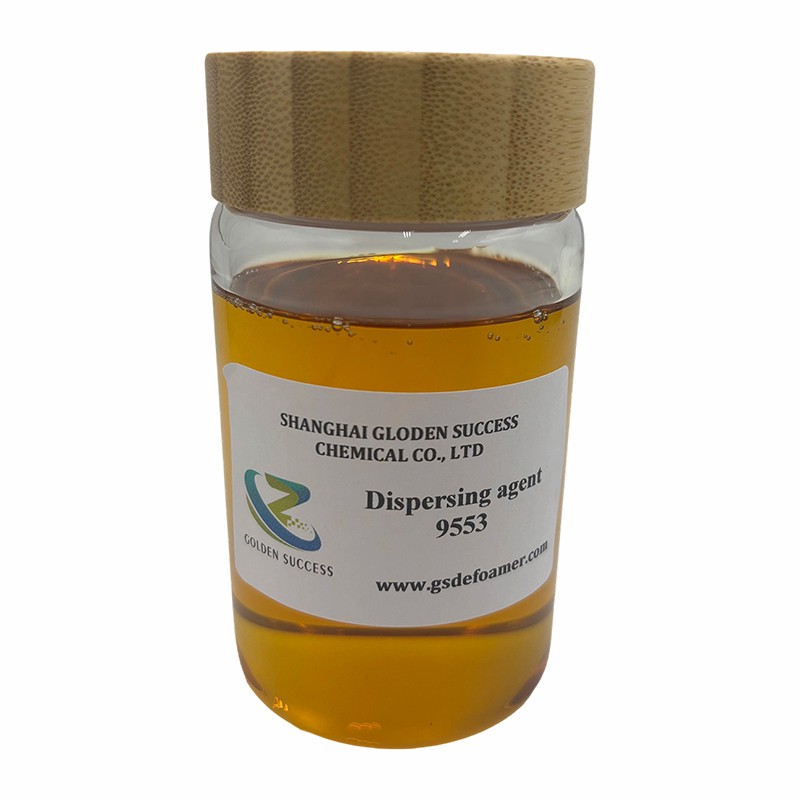
Another important aspect is the molecular weight of the polymers. High - molecular - weight polymers can be a bit tricky to handle. They have longer chains and more complex structures, which can lead to issues like entanglement and poor dispersion. But our Dispersing Agent 9553 is formulated to deal with such polymers. It has the ability to penetrate the polymer chains and break up any aggregates, ensuring a more homogeneous distribution in the oil phase.
Now, let's talk about how we test the compatibility. We use a variety of techniques in our lab. One common method is to visually inspect the samples. After adding the dispersing agent to the polymer - oil mixture, we look for signs of phase separation or clumping. If the mixture remains uniform over a period of time, it's a good indication of compatibility.
We also use particle size analysis. This helps us determine the size of the dispersed particles. A well - dispersed system will have smaller, more uniformly sized particles. If the particle size is too large or shows a wide distribution, it might mean that the dispersing agent is not working effectively with the polymer.
In addition, we measure the viscosity of the mixture. Compatibility can often be related to changes in viscosity. If the dispersing agent is compatible with the polymer, it can lead to a more stable viscosity over time. An increase or decrease in viscosity that is not in line with the expected behavior can be a sign of poor compatibility.
When it comes to real - world applications, having a good understanding of the compatibility is crucial. In the paint industry, for example, using the right dispersing agent with the polymer in the paint formulation can result in a smooth, even finish. If the compatibility is off, the paint might have issues like sagging, peeling, or uneven color distribution.
In the lubricant industry, proper compatibility ensures that the lubricant can perform its function effectively. It helps in reducing friction and wear between moving parts. If the dispersing agent doesn't work well with the polymer in the lubricant, it can lead to deposits and a decrease in performance.
So, if you're in the market for an oil-based dispersing agent and want to make sure it's compatible with your polymer in an oil system, we're here to help. Our team of experts has years of experience in this field and can provide you with the best advice. We can also offer samples for you to test in your specific applications.
Whether you're dealing with small - scale projects or large - scale industrial production, we've got the solutions. Don't hesitate to reach out to us for more information on our products and how they can work for you. You can get in touch with us to start discussing your requirements and see how we can meet your needs for a well - dispersed, high - performance oil system.
References:
- Smith, J. (2018). Handbook of Polymer - Dispersing Agent Interactions. Chemical Press.
- Johnson, A. (2019). Compatibility Studies in Oil - Based Systems. Industrial Journal of Chemistry.