

Thickening Agents
Your Professional Thickening Agents Supplier
Our goal is to be your true partner in Thickening Agents field in China.Shanghai Golden Success is specializing in Defoamers, Wetting agents, Leveling agents, Dispersing agents, Thickening agents, Alkynyl alcohol surfactants and Fluorocarbon surfactants, etc. We have over 20 years experience in R&D and producing the additives, and our factory covers more than 30,000 square meters in Anhui province.


Why Choose Us
Rich experience
We have over 20 years experience in r&d and producing the additives, and our factory covers more than 30,000 square meters in anhui province.
R & d capabilities
We have our own laboratory, which ensures our r&d capabilities and enables us to improve and develop new products according to the needs of our customers.
24h online service
If you have difficulties when using the product, we will respond to your needs as soon as possible and give you the greatest support.
Global shipping
Our products support global shipping and the logistics system is complete, so our customers are all over the world.
Advantages of Thickening Agents
Thickeners can significantly increase the viscosity of melts or liquids, prevent flow during construction, and ensure that the product will not sag, drip or splash during construction, thereby improving the stability and rheological properties of the product.
In water-based adhesives or latex coatings, thickeners can not only prevent flow during construction, but also give the product excellent mechanical properties and long-term storage stability. At low shear rates, thickeners can significantly increase the viscosity of the system, while at high shear rates, the effect is minimal. This feature makes it play a core role in the thickening, stabilization and rheological property adjustment of latex coatings or water-based adhesives.
In the manufacturing process of adhesives and sealants, thickeners can effectively prevent filler precipitation and pigment agglomeration, and improve the uniformity and stability of the product. For example, during emulsion polymerization and latex preparation, thickeners can protect colloids and improve emulsion stability.
During construction, thickeners can flexibly adjust the viscosity of coatings or water-based adhesives, showing excellent thixotropy, ensuring smooth construction without sagging or dripping, while slowing down the rate of water loss of the film, increasing the glue application surface at one time, and improving construction efficiency.
Many thickeners are natural or synthetic hydrophilic polymer compounds, which have environmental advantages and safe, environmentally friendly, pollution-free formulas, and are not flammable or explosive. For example, cellulose thickeners such as methyl cellulose and carboxymethyl cellulose are highly praised for their excellent performance.
Classification by ionic properties
Anionic type: Such as sodium carboxymethyl cellulose, alginic acid, etc., provide thickening effect through acidic groups such as carboxyl groups.
Cationic type: Such as polyquaternary ammonium salts, thickening is achieved through positively charged amino groups.
Non-ionic type: Such as hydroxyethyl cellulose (HEC), polyvinyl pyrrolidone (PVP), etc., do not contain ionic groups and have high stability.
Classification by source
Natural type: Polysaccharides or protein substances extracted from plants (such as starch, pectin), seaweed or animals (such as gelatin).
Synthetic type: Prepared by chemical synthesis, such as sodium polyacrylate, polyurethane thickeners, etc.

Classification by chemical structure
Polysaccharides: Such as starch derivatives (methyl cellulose), xanthan gum, etc., form a gel structure through the water absorption and expansion of the molecular chain.
Protein: Such as casein and sodium caseinate, which use the colloidal properties of protein to thicken.
Polymer: Such as polyurethane thickener (HEUR), which achieves thickening through the association of hydrophobic groups.
Classification by molecular weight
Low molecular weight: Such as fatty alcohols and inorganic salts (such as sodium chloride), which thicken by changing the solution structure.
High molecular weight: Such as cellulose ethers and polyacrylic acids, which increase viscosity by forming a network structure.
Other classification methods
By application area: Food grade, cosmetic grade, industrial coating grade, etc.
By functional properties: Such as thixotropic type (good fluidity at low shear, thickening at high shear), leveling type (improving coating uniformity), etc.
Product Description
|
Index |
Result |
|
Appearance |
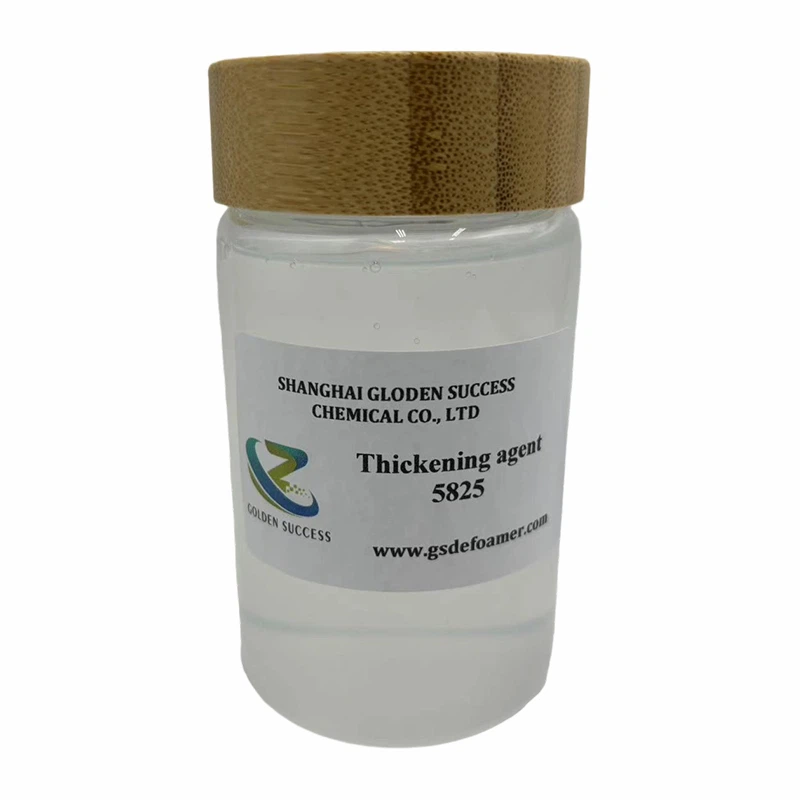
Colorless or light yellow viscous liquid (25°C) |
|
Effective PU solid content |
20±2% |
|
Density (25°C) |
1.04±0.02 g/cm3 |
|
Lonicity |
Non-ionic |
Lead Time
|
Quantity (kilograms) |
1 - 1000 |
> 1000 |
|
Lead time (days) |
7 |
To be negotiated |
Packaging & Shipping
In 20/25kg paper bags inner with PE bags
20'FCL:10 tons with pallets or 11 tons without pallets

Storage &Transportation:
-No Damage during the transportation;
- Protect from Humidity, Rain, Sunlight, Damp and wet;
-Put in dry and ventilated Place During storage;
- Remind must be promptly sealed and packed to prohibit from wet.
FAQ
We're well-known as one of the leading thickening agents manufacturers and suppliers in China. Please feel free to buy cheap thickening agents for sale here and get free sample from our factory. For price consultation, contact us.